There is no shortage of studies on how to achieve the best possible effect from advertising. Well-founded, accessible and clearly presented results. Yet many marketers do exactly the opposite—more and more so.
That was the conclusion of Andrew Tindall from the British research company System1, which uses behavioural science to predict the outcomes of marketing activity.
He spoke recently at a seminar organised by the Swedish Advertisers’ Association and its global body, the World Federation of Advertisers (WFA), as part of Global Marketer Week. Marketers from 40 countries gathered in Stockholm, and the week concluded with an open lecture day at Folkets Hus.
Andrew Tindall’s work builds on and develops the important studies carried out by his colleague Orlando Wood on creative effectiveness, presented in books such as Lemon and Look Out!.
“We have never spent as much on advertising as we do today. Spending has increased by 30 per cent since 2009. But have the effects increased by 30 per cent? No, they have not,” said Tindall, referring to the studies by Les Binet and Peter Field.
They have shown that brands with a higher Share of Voice than market share can achieve stronger growth—what they describe as ESOV (Excess Share of Voice). They have also demonstrated that long-term brand building drives long-term sales growth, typically recommending that around 60 per cent is invested in long-term brand building and 40 per cent in short-term activation.
And to build brands, broad-reach media with high attention are needed.
“Are you doing that? No—quite the opposite. You are investing more and more in low-attention media.”
In 2019, the split was roughly 50/50, but since then low-attention media have overtaken and now account for around 70 per cent of media investment.
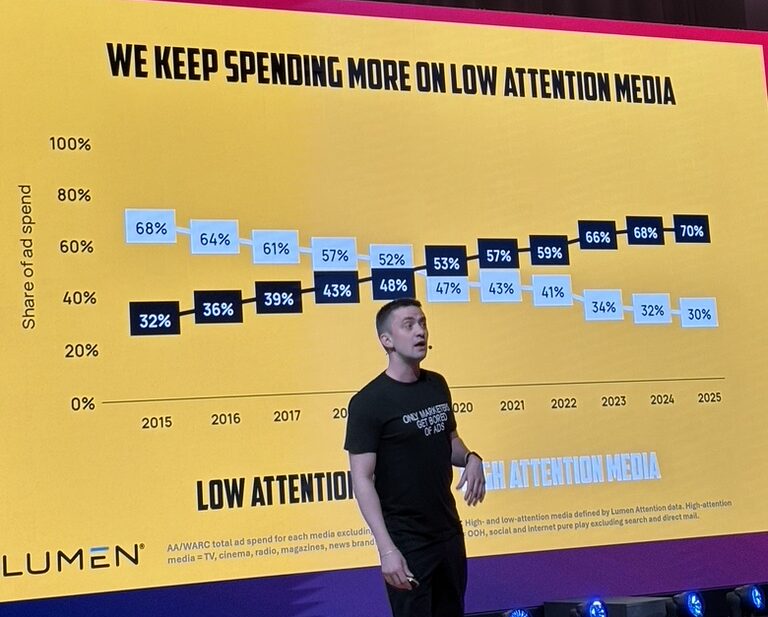
“Brand effects decline at the same rate as the pursuit of short-term effects increases,” Tindall concluded, before admonishing the marketers in the audience:
“Naughty, naughty marketers!”
CREATIVITY MATTERS MOST
A high level of creativity amplifies media investment. This has been shown in the studies by Binet and Field, as well as in the results presented by Niklas Bondesson from the 100-watt awards.
Tindall pointed out that Effie data shows that creatively awarded campaigns generate growth of 2.8 per cent, compared with an average of just 0.6 per cent across all campaigns.
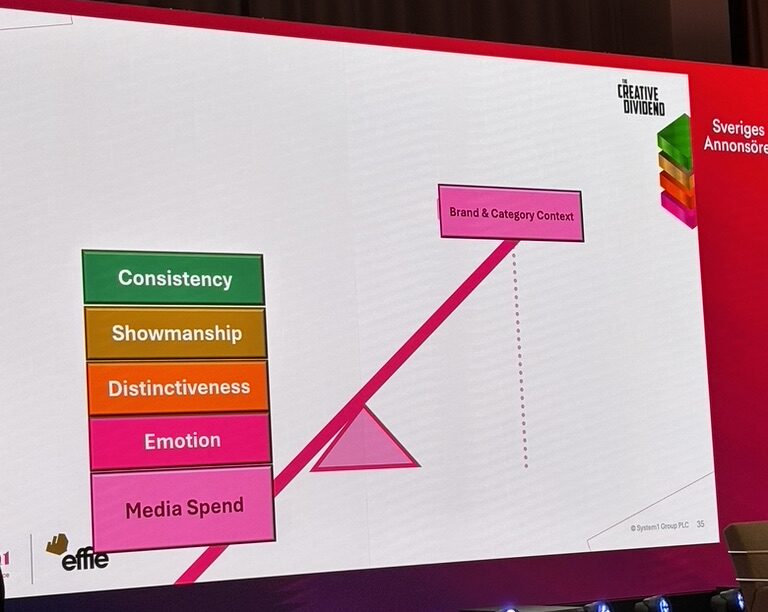
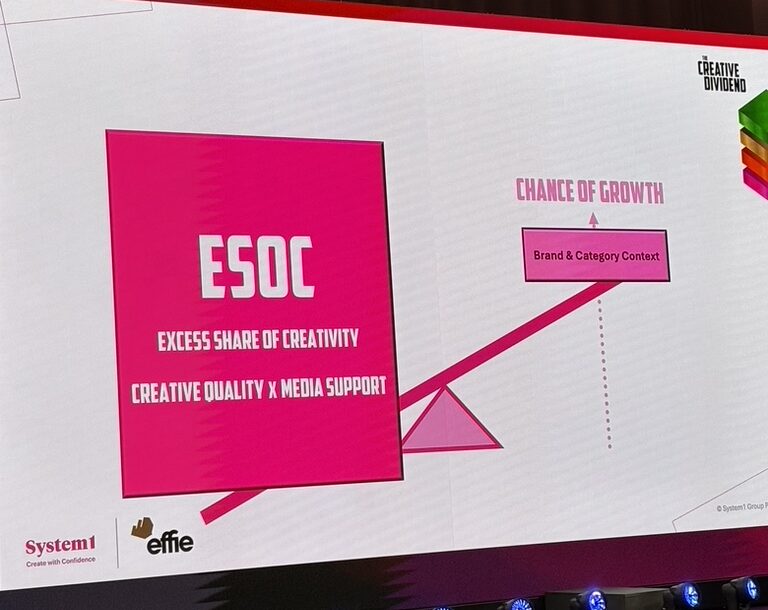
He illustrated this with a seesaw, where media investment combined with creativity on one side lifts brand perception on the other—leading, in turn, to increased growth potential.
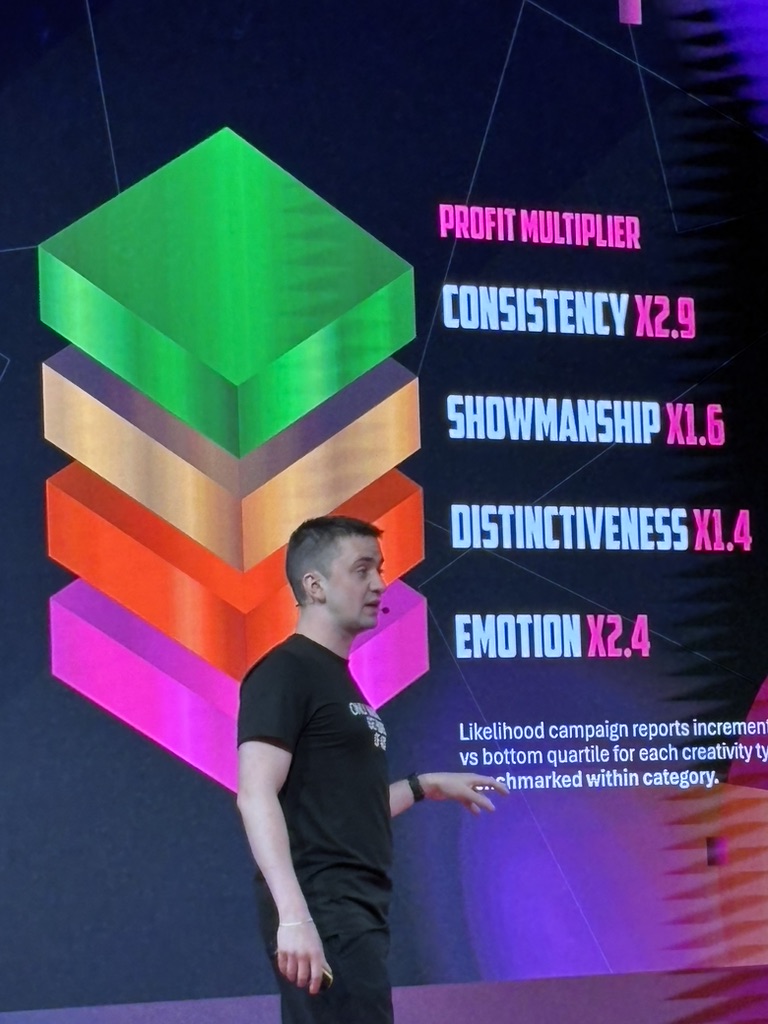
Tindall defined four key factors that together form what he described as a “creativity stack”. The more of these factors that are layered together, the greater the likelihood that advertising will drive growth:
- Consistency and long-term commitment: multiplier of 2.9
- Showmanship: multiplier of 1.6
- Distinctiveness and clarity: multiplier of 1.4
- Emotion: multiplier of 2.4
Clarity is a fundamental requirement.
“If people don’t understand which brand it is, then it isn’t even advertising,” Tindall noted.
Different assets—or brand cues—help make the brand quickly recognisable: a logo, a piece of music, a character or celebrity, the visual identity or a specific colour, for example.
Tindall showed a Tesla commercial to illustrate the point. In many ways, a fairly typical car ad: glossy surfaces, winding roads. But certain details—such as the door handles—were recognisable as Tesla. And to make sure, the film ended with the logo in full screen.
Measurements showed that the film achieved maximum scores for clarity.
So it must have been good advertising? Not at all. Tesla was clear—but not effective. The film did not evoke any emotional response.
STARS THAT SHOW THE WAY
System1 has developed a system for measuring emotional response, based on people’s facial expressions. They have identified eight emotional states—such as anger, happiness, surprise or neutrality.
The stronger the emotional response, the greater the potential effectiveness. This is graded in stars, from one star indicating low potential to five stars indicating exceptional potential.
The Tesla film achieved only 1.5 stars.
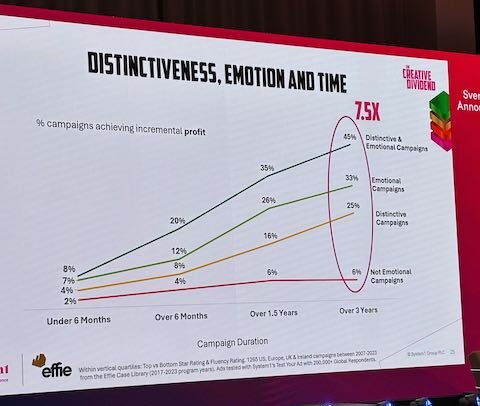
Striving to evoke emotion is a sound strategy for building profitability—especially if one has the patience.
Differences appear relatively quickly, but become increasingly clear over time. After just six months, distinctive campaigns are twice as profitable as neutral ones, while emotional campaigns are three times as profitable.
After three years, the incremental profit reaches 6 per cent for neutral campaigns, 25 per cent for distinctive campaigns and 33 per cent for emotional campaigns.
But when distinctiveness is combined with emotion, the outcome is significantly stronger: 45 per cent.
So why is this not what marketers are doing?
Since the early 2020s, investment in both short-term activation and digital media has overtaken brand building and emotional advertising.
Another important factor for success is the ability to entertain.
As Orlando Wood pointed out at Cannes Lions a few years ago, the difference is between salespeople and entertainers. It is the entertainers who break through.
“We have lost our creative confidence. We need to entertain to win,” Tindall emphasised.
EMOTION AND ENTERTAINMENT CREATE STAR POWER
Binet and Field speak about ESOV—Excess Share of Voice.
But Tindall prefers to talk about ESOC—Excess Share of Creativity.
He illustrated this with another commercial, for the confectionery brand Twix.
Here, the results were superior across all dimensions compared with the Tesla ad, indicating both short-term and long-term success. The film achieved 4.8 stars, signalling strong long-term growth potential, and brand recognition reached 99 per cent. System1 also measured exceptional short-term sales potential.
Yet marketers continue to act against their own best interests. Long-term brand-building advertising is declining. Emotional advertising is declining even more. At the same time, investment in short-term objectives and digital media is increasing sharply.
“Naughty, naughty marketers!” Tindall repeated, highlighting the importance of accumulated creativity—the result of consistent brand-building over time.
This is based on three mutually reinforcing factors:
First, stable creative foundations are required. A consistent positioning, ideas that are allowed to live over time, and long-term agency relationships. When direction changes too frequently, nothing has time to stick.
Second, a culture of long-term thinking is needed. Creative ideas must be given time to embed, the same expression should be recognisable across all channels, and successful creative elements should be reused rather than reinvented each time.
Third, consistent execution over time is essential. The same visual cues, the same sound or music, and the same tone ensure immediate recognition. It is this repetition and recognition that allows creativity to accumulate and grow in effect over time.
This is how ESOC is created—high creative quality combined with strong presence in high-attention media. When that happens, the seesaw tips decisively, creating the strongest potential for growth.
A RECEIPE FOR SUCCESS
Tindall’s message was clear: creativity and media need to start working together again.
When both creative quality and media support are strong, what emerges is best described as a growth engine. It does not get better than that. The key is to stay on the same path over time and not lose patience.
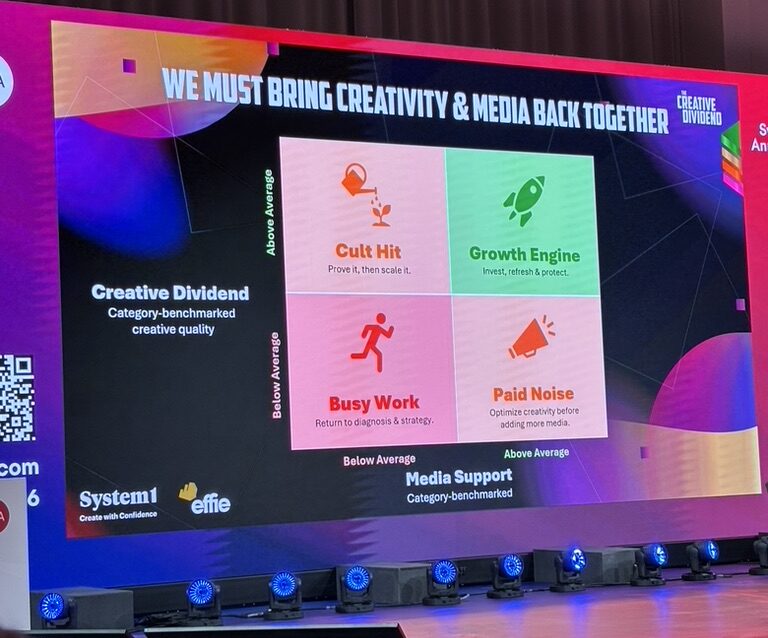
When creativity is strong but media support is weak, an idea can still become a cult success—small but effective. In that case, the task is to document the success and then scale it.
Conversely, large media budgets without sufficiently strong creativity risk becoming nothing more than paid noise. In that case, creativity needs to be strengthened before further investment is made. Otherwise, it will simply result in more wasted money.
And when both creativity and media support are weak, a great deal of work may have been done—but without achieving any real effect. Then it is necessary to start over and do it properly. Both analysis and strategy need to be reworked from the ground up.
It is also striking how much greater growth can be achieved through long-term consistency. The most consistent advertising delivers almost twice as many business results as the least consistent.
So the problem cannot be a lack of knowledge.
It is rather a lack of willingness to apply that knowledge.
And a lack of patience to work long term.

2 thoughts on “Naughty, Naughty Marketers!”