There are by now countless studies clearly demonstrating the value of long-term, highly creative communication when it comes to building strong brands that increase profitability for companies and generate returns for shareholders.
Yet so much advertising remains dull and cautious. One really has to ask why that is.
That was also the question Jon Evans (founder of analytics company System1) and Adam Morgan (founder and CEO of strategy consultancy Eatbigfish) had asked themselves.
They concluded that one reason may be that companies simply have not realised what dull advertising actually costs. So it was time to find out.
System1 has developed a model for measuring emotional reactions to advertising among viewers of British and American television commercials. The reactions are sorted into eight categories: contempt, disgust, anger, fear, sadness, happiness, surprise and neutrality.
A total of 160,000 British and American commercials have been tested.
“One reaction is surprisingly common in these tests – people feel absolutely nothing when they watch the advertising. They are completely indifferent,” Jon Evans explained.
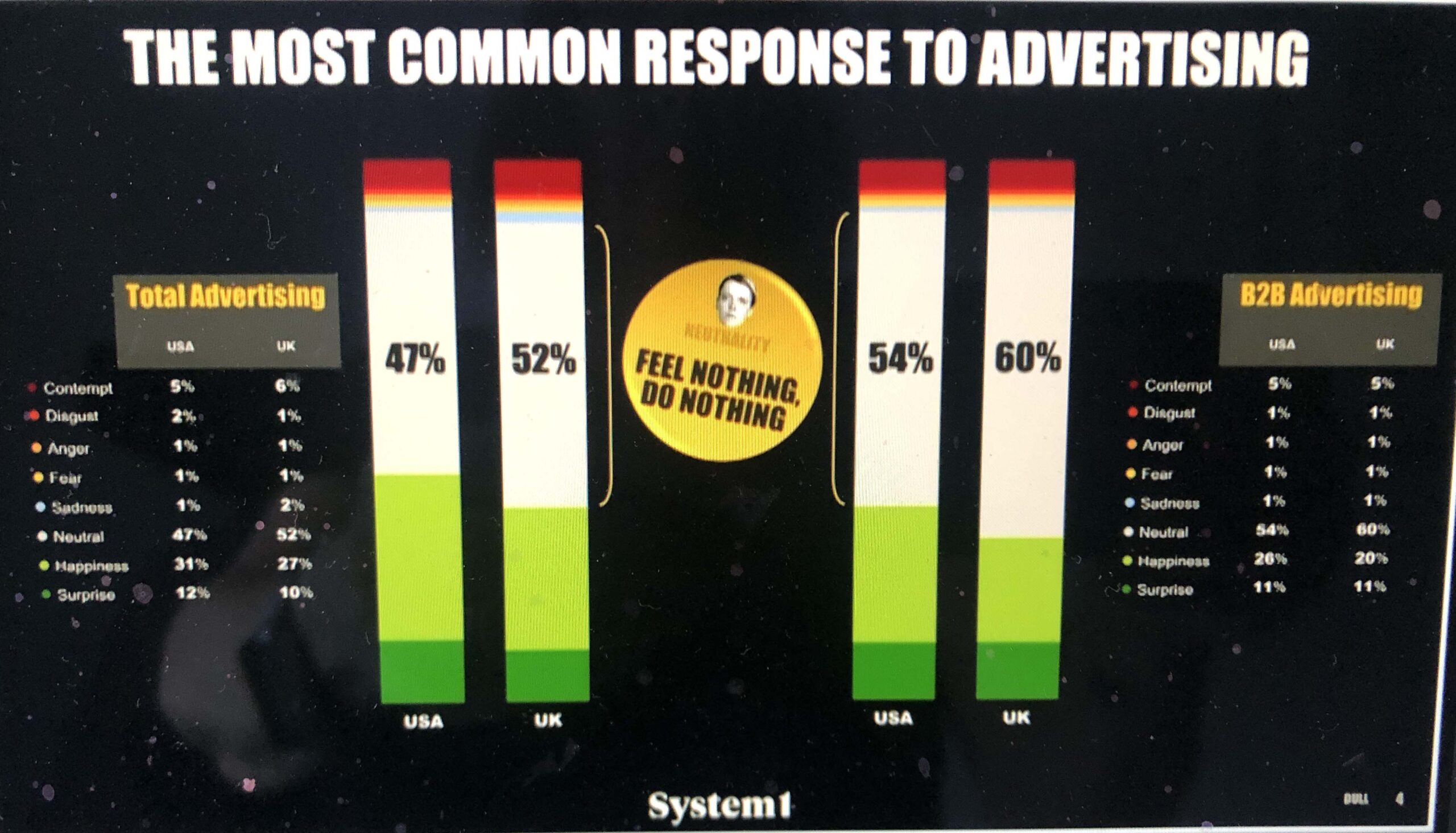
It is so bad that roughly half of audiences in both the US and the UK feel nothing at all when they watch advertising. They remain emotionally neutral.
But it is even worse in B2B communication, where 60 per cent of audiences are unaffected.
“So does it really matter if you bore the audience?” Jon Evans asked rhetorically, referring to Les Binet and Peter Field, whose analysis of the IPA databank showed that emotional advertising is twice as likely to generate large business effects as rational advertising.
He also quoted Daniel Kahneman, who observed that “the pain of losing something is twice as powerful as the pleasure of gaining something”.
This led Jon Evans, Adam Morgan and Peter Field to reverse the usual question. Instead of asking how much emotional advertising gains, they wanted to investigate how much companies lose through dull advertising that triggers no emotional response at all.
“How expensive is it to be dull? What is the exact cost in pounds, dollars or whatever currency you choose?” Adam Morgan asked.
CLEAR EVIDENCE OF THE PRICE OF DULLNESS
Peter Field once again analysed all the campaigns in the IPA databank and compared how much a successful but rationally dull campaign needed to invest in order to achieve the same impact as a more emotionally engaging campaign.
The answer was that dull campaigns needed to invest 7.3 percentage points more than emotional campaigns. In the UK, this corresponds to an additional investment of approximately £10 million per campaign.
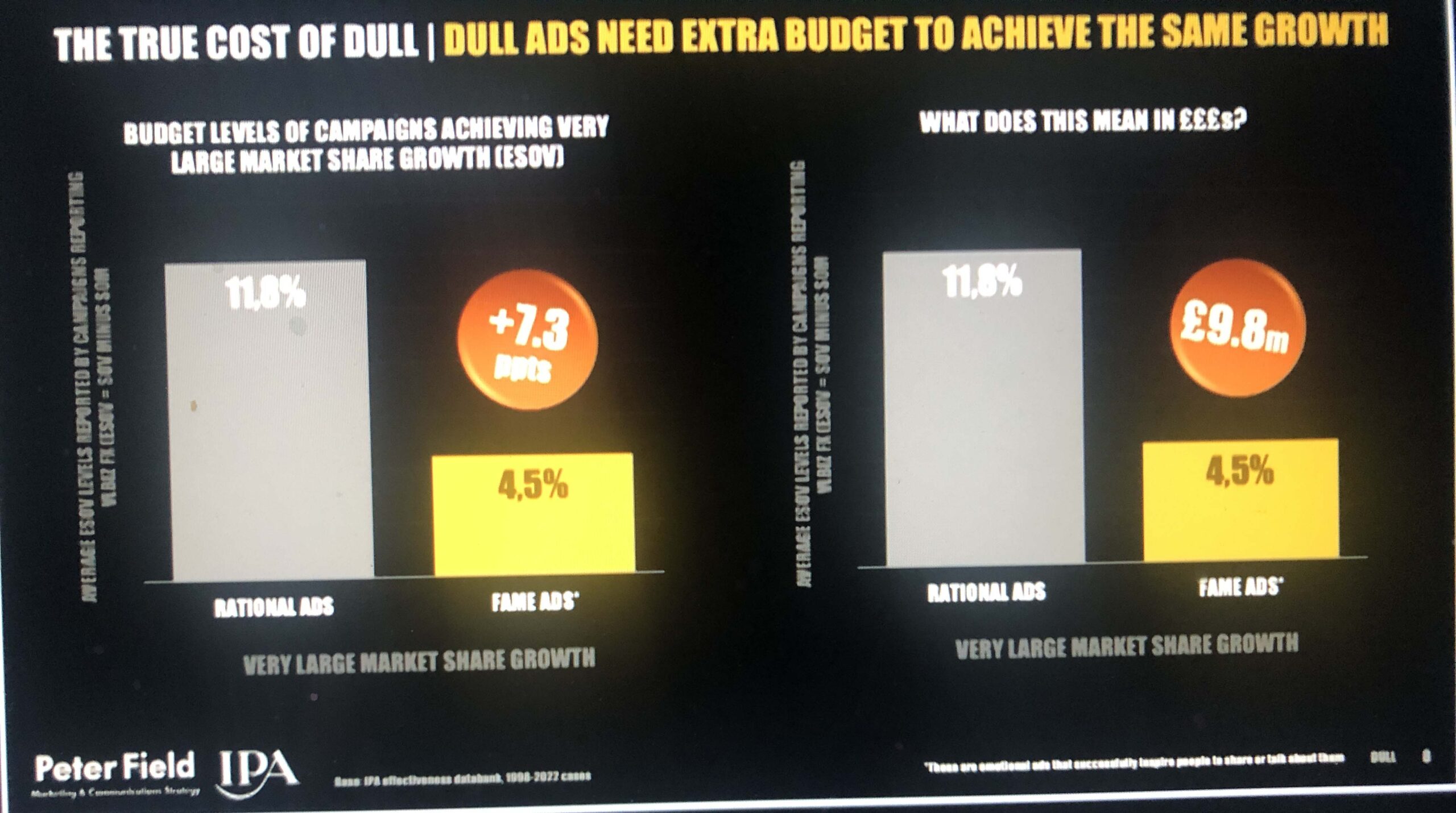
“You can choose to be dull. But it is more expensive. That could lead to a rather interesting conversation with your CFO,” Adam Morgan noted.
Another way of calculating the cost of dull advertising was to analyse System1’s tests of 55,000 US television campaigns over a six-year period. These campaigns were divided into four levels, ranging from the most interesting to the dullest.
The results clearly showed how much more growth the most engaging advertising generated.
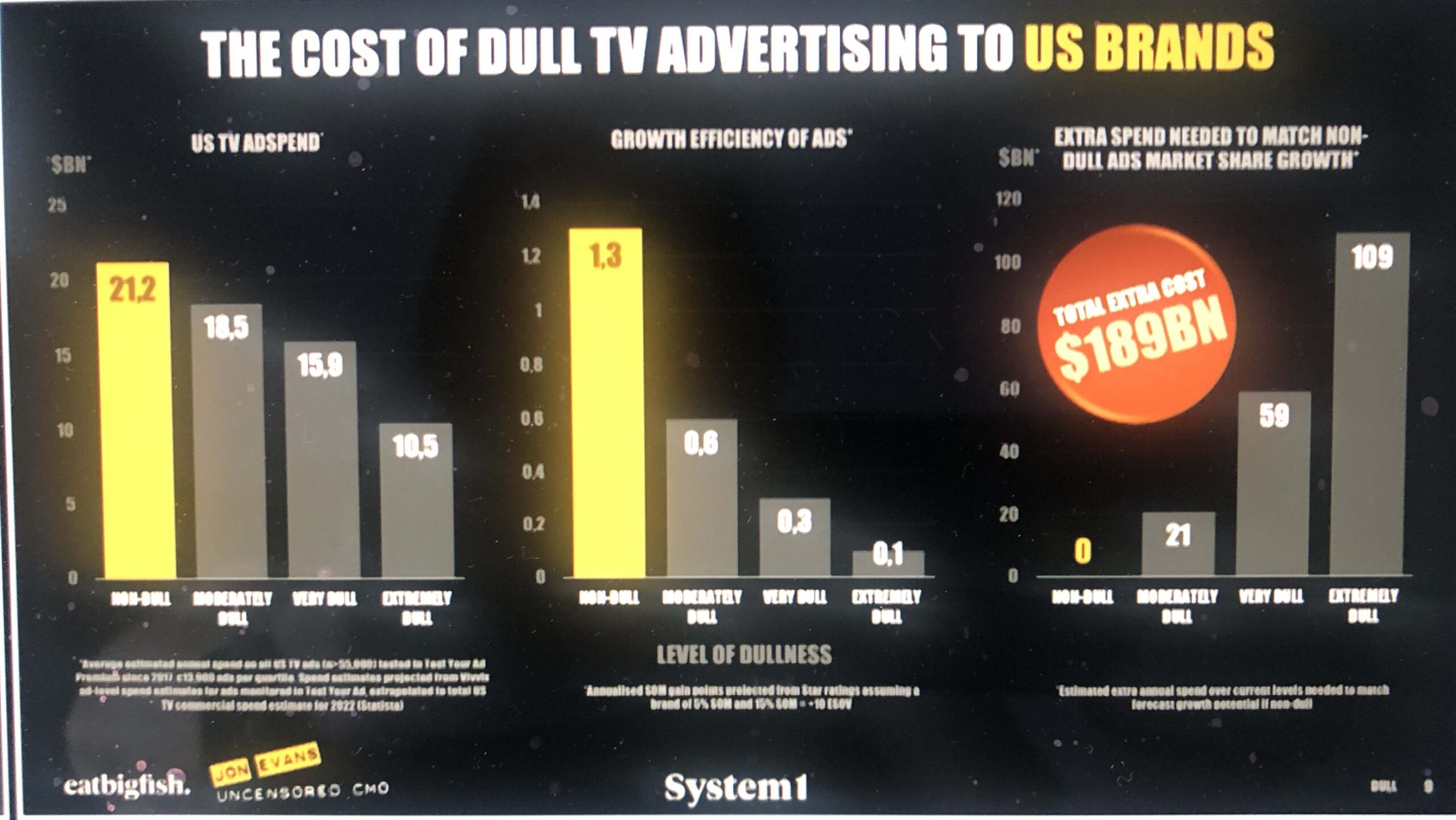
But they also made it possible to calculate exactly how much more the duller campaigns needed to invest in order to achieve the same effect as the most engaging advertising.
“The answer was that they needed to invest a total of 189 billion dollars in order to achieve the same effect as the most interesting advertising. That is roughly equivalent to the entire GDP of Greece,” Adam Morgan concluded, wondering whether one should laugh or cry at the findings.
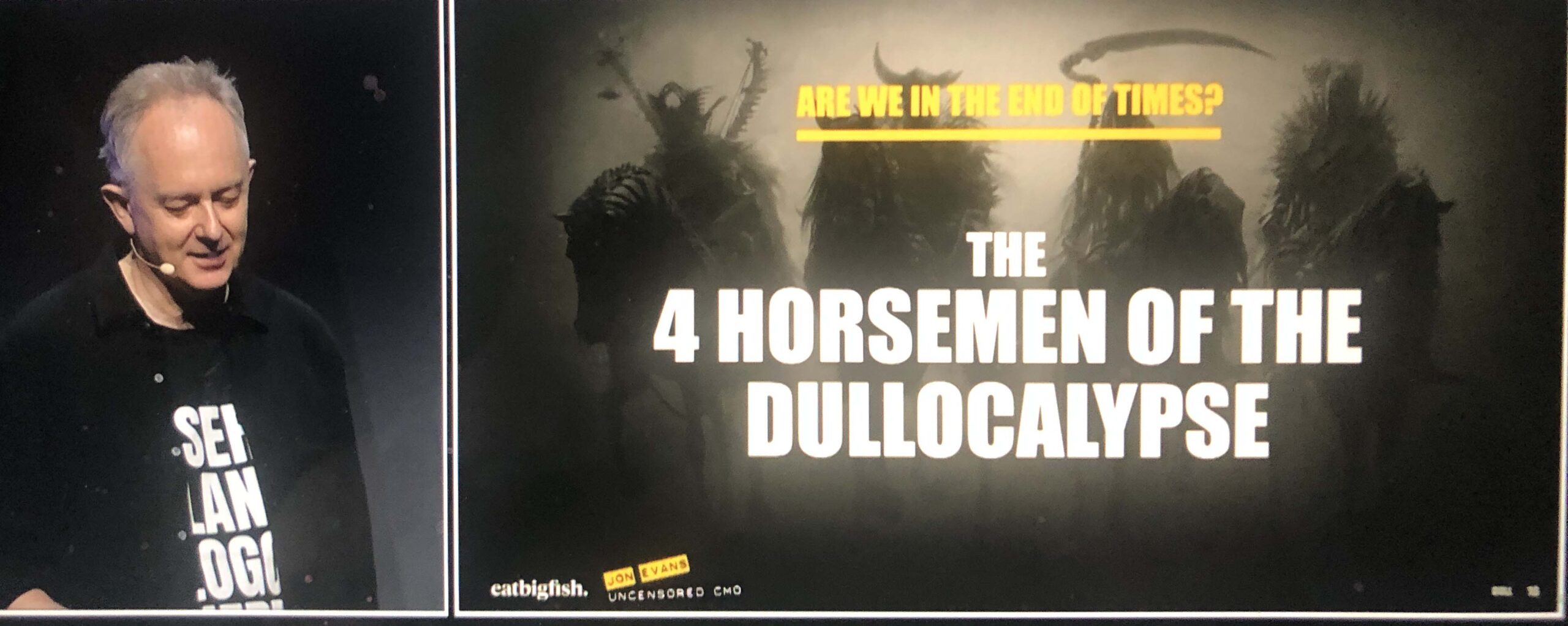
He then pointed to four clear causes behind increasingly dull advertising and growing audience indifference.
These were illustrated by “The Four Horsemen of the Dullocalypse”: Performance, Optimisation, Average-ness and Procurement.
PERFORMANCE MARKETING
Jon Evans argued that the developments of the past 20 years – particularly technological developments – have changed both the way we communicate and the conditions under which communication operates.
Advertising has increasingly moved away from more engaging media towards duller ones. Television, where brands can tell stories and capture audiences, has steadily declined. Instead, advertising has shifted towards digital platforms such as Meta, where brands often have only a few seconds to reach people.
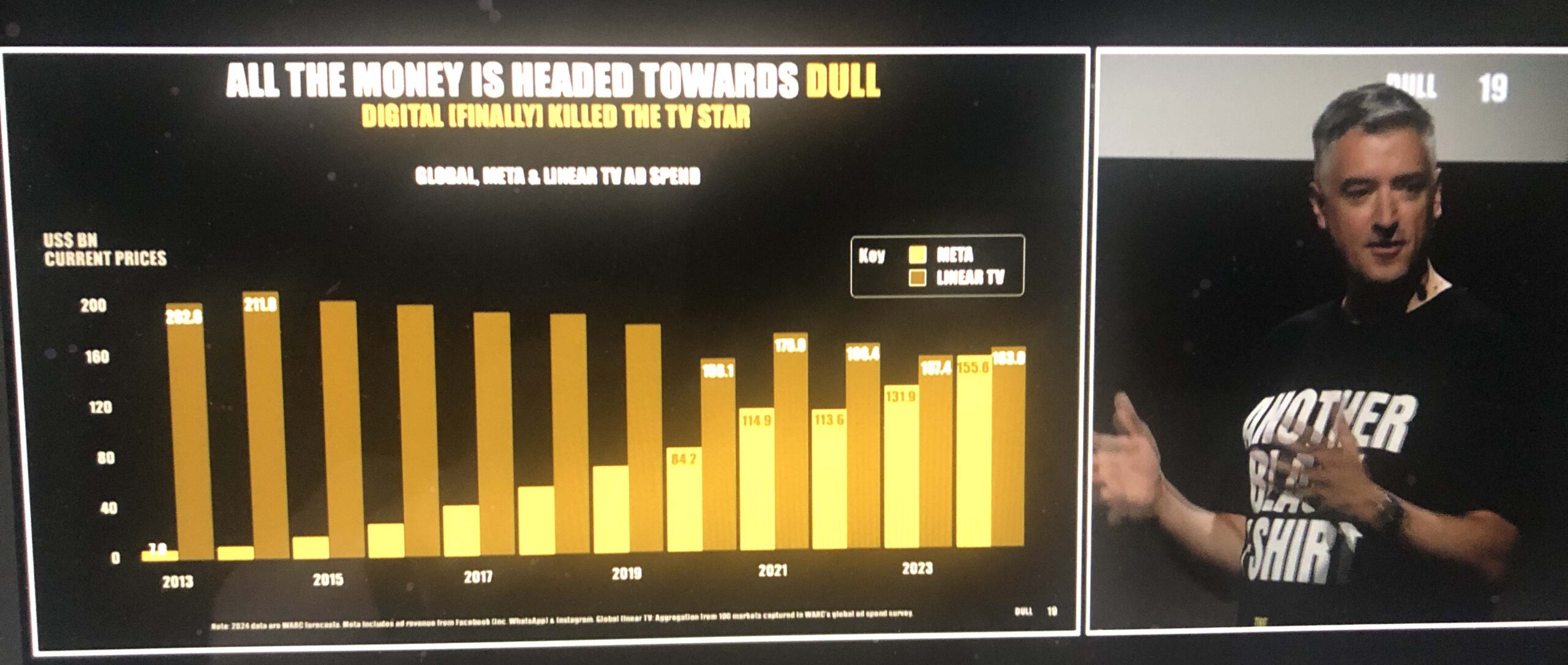
“A new generation of marketers has emerged from performance marketing and shifted communication towards repetitive, rational and dull advertising that tries to persuade people to buy immediately. Instead of the kind of showman advertising that we know works far better – advertising that creates memories, emotions and long-term effects,” Jon Evans explained.
He then showed a clip from his podcast, where he interviewed Colleen DeCourcy, Chief Creative Officer at Snap.
She was very clear about the limitations of performance marketing:
“You need a strong brand, a message that really sticks, or a point of view that people genuinely care about. The moment you stop investing in that, performance marketing stops working as well.”
OPTIMISATION
“Why are so many talented people spending their time producing so much nonsense? It cannot be because this is a stupid industry, or because people intentionally want to create dull work,” Adam Morgan reflected.
He believed optimisation and average-ness are two major reasons why apparently sensible decisions end up producing unintended consequences.
To illustrate this, he pointed to a long list of companies that have recently redesigned their logos.
“Of course, the reasoning is often that brands need to work across many different platforms – tiny on some screens, huge on others. So they need to become simpler and easier to read. Which means redesigning the logo.”
But two things then happen. First, the character and distinctiveness disappear completely. Second, all the redesigned logos start looking almost identical.
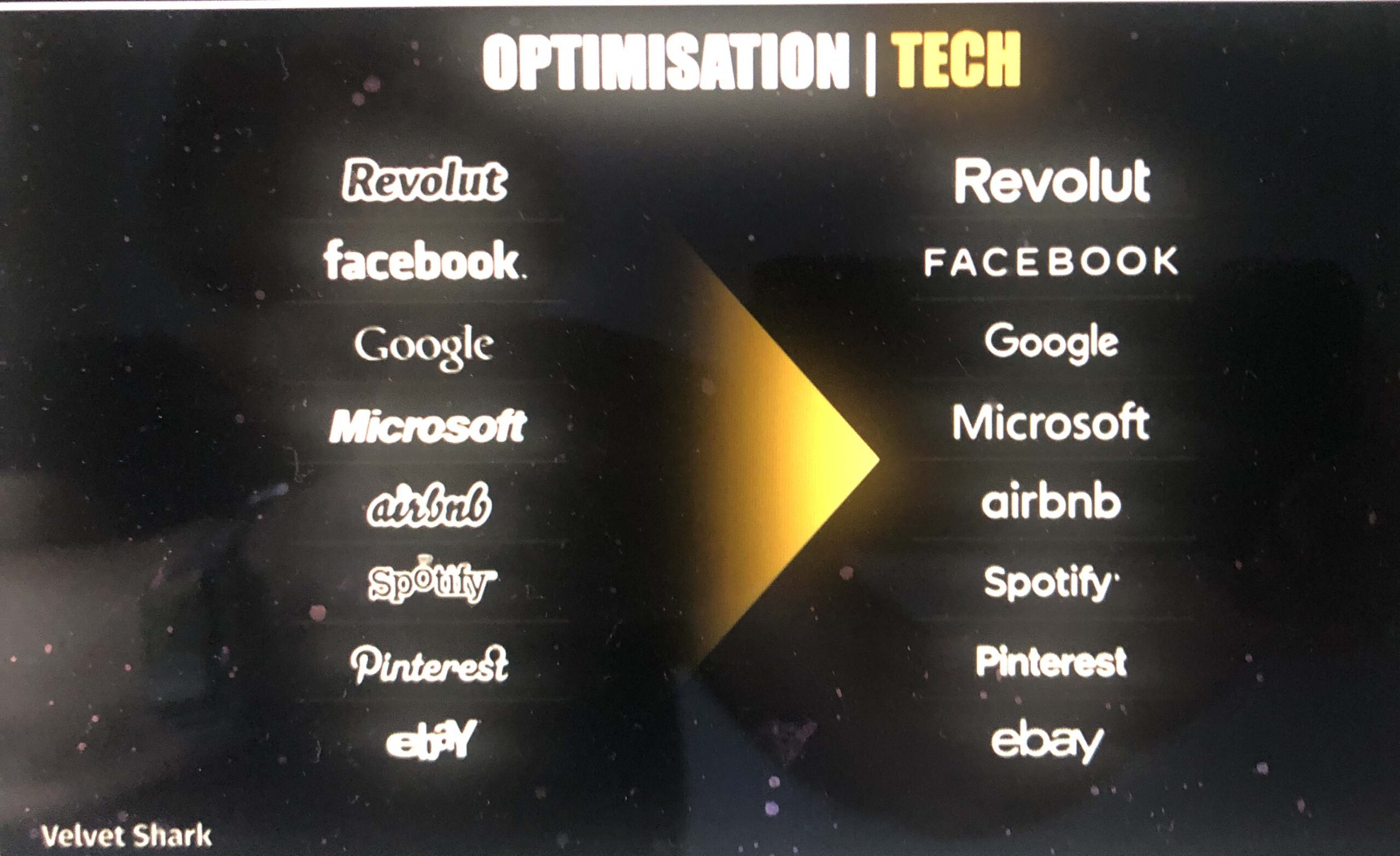
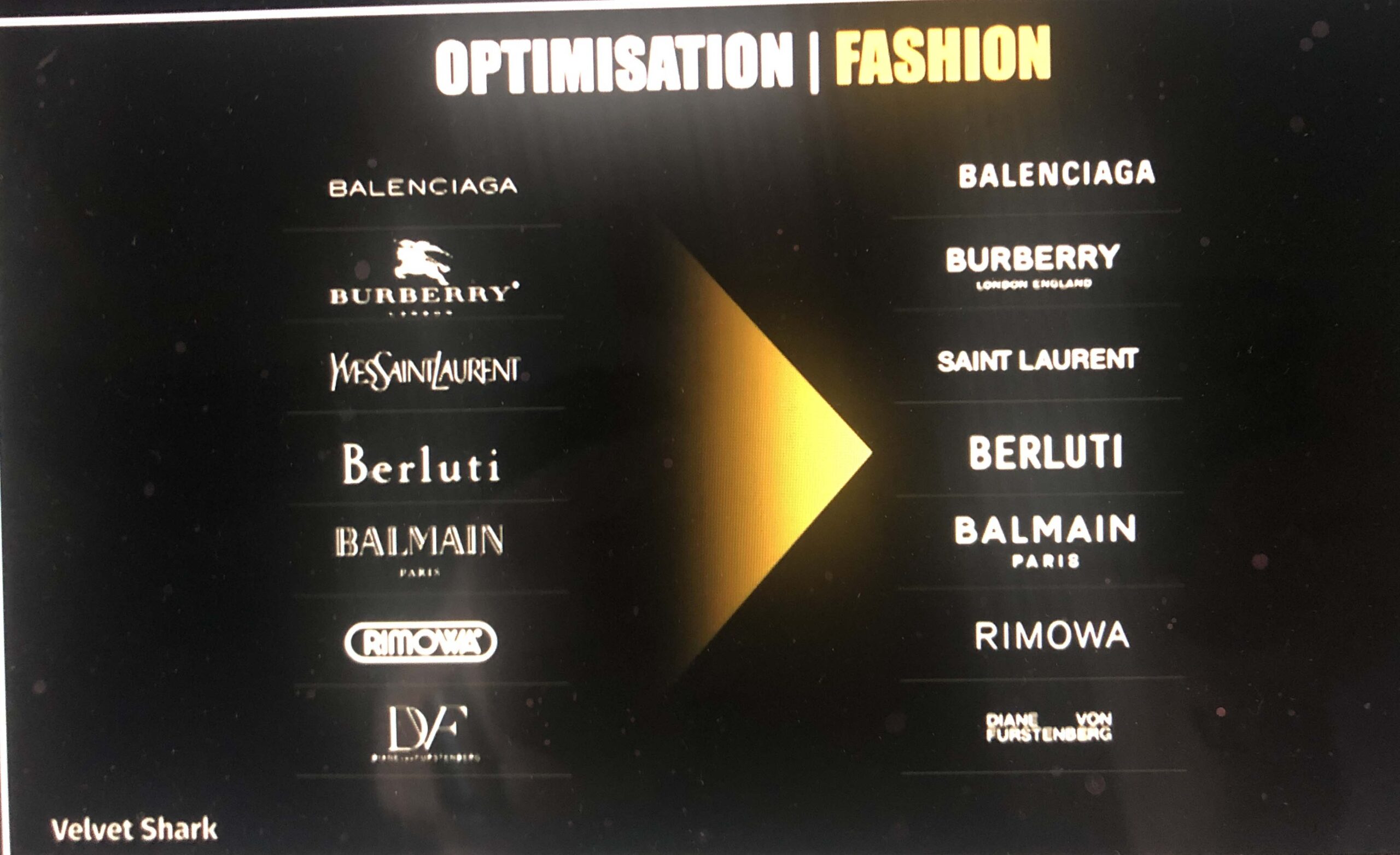
“Perhaps this only applies to tech companies. Rational engineers. That might seem understandable. Surely it must be completely different in fashion,” Adam Morgan joked.
“But it is not. It is just as bad there.”
He pointed out that the logo is the very heart of the brand – yet in all these examples, brands have become increasingly similar.
“And that leads us to average-ness.”
AVERAGE-NESS
The combination of algorithms and social media increasingly makes everything look the same.
Even different car brands are starting to resemble each other more and more.
“Of course, it may make sense for car manufacturers to use the same underlying platform. But it becomes increasingly difficult to tell them apart,” Adam Morgan noted, showing an image of 25 different SUV brands that looked remarkably similar.
[Här skulle jag eventuellt korta själva SUV-exemplet något. Inte huvudpoängen – bara detaljnivån.]
PROCUREMENT DEPARTMENTS
“When I first started as an account manager, my boss told me that my job was to understand what the client wanted and what the client actually needed. Then it was my job to help them want what they needed. But today, when agencies are forced to accept fees at cost level or even below, that no longer works,” Adam Morgan explained.
“Agencies may begin with the ambition of giving clients what they truly need. But over time, that becomes impossible. It simply is not financially sustainable.”
He then connected this back to Peter Field’s findings that dull advertising costs £10 million more per campaign than genuinely good advertising.
“That raises an interesting question: when companies focus aggressively on cost control, are they actually saving money – or simply wasting it in another way?”
Jon Evans reminded the audience that the growing focus on AI has effectively supercharged the four horsemen.
So companies now face a choice.
“If you have the money, you can choose to spend the extra £10 million on dull advertising. But imagine the agencies, creatives and influencers you could work with instead if that money were invested wisely,” he concluded.
